

2020 was not all doom and gloom :)
- Mathias Talmant

- 27 déc. 2020
- 5 min de lecture

Only the world wars have rivalled covid-19 for news coverage and yet, armed combat have a much higher fatality rate. However, the new coronavirus has altered people’s daily routines in almost every country, in a way that deadlier events did not.
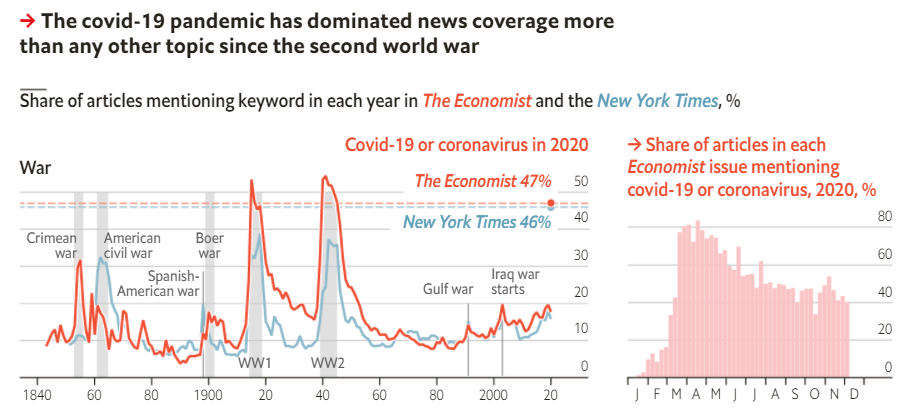
Source: The Economist
Media coverage is a flawed gauge of importance, because journalists focus too much on bad news and too little on improvements, which happen more gradually. Let me give you some hope for the decade to come with my TOP TEN HAPPY NEWS OF 2020.
Nothing in nature blooms all year and not even 2020 was a fruitless year 😊
#1 / Everyday heroes in the spotlight
This may be a short-lived introspection, but I reckon COVID-19, a global and non-discriminatory disease, will have anthropological repercussions. It will change the way we perceive other citizens of our society.
It is sad, but we needed a pandemic to change our definition of Real-Life Superheroes to include doctors, nurses, garbage collectors, truck drivers, cashiers and many more. At the pinnacle of the crisis, we gained humility and appreciated the selfless dedication of those we tend to forget and denigrate. This is a win for Humanity with a capital H.
#2 / Quest for Global Health
Africa was certified free from wild poliovirus, a disease that typically affects children under five and can lead to paralysis and death.
The World Health Organization revealed in November that malaria deaths reached the lowest level ever recorded and tuberculosis is also disappearing. Almost 70 mn deaths were averted globally since 2000. In addition, the official number of reported cases of hepatitis B in children under age five had dropped below 1%.
Since 2010, new HIV infections have fallen globally by 23% and a new drug (Cabotegravir) could prevent HIV infection with only six injections per year.
Scientists in Australia reported promising early studies of a new cancer vaccine that could be used to treat blood, breast, lung, renal, ovarian, and pancreatic cancers.

#3 / Terrorism is losing ground
Terrorism risk is more widespread and not bounded to South Asia and Africa anymore. Nevertheless, the Global Terrorism Index reported that deaths from terrorism fell for the fifth consecutive year in 2020 (-59% since 2014 to 13,826). The global economic impact was also divided by 4 between 2014 and 2019.
Furthermore, researchers found that the terrorism situation had improved in 103 countries. The largest decreases in deaths were in Afghanistan and Nigeria. France is the 38th riskiest countries among the 163 nations.

#4 / Mass extinction in standby
Global warming and animal conservation remain the most critical issues of the century, but efforts are paying off. Indeed, 48 bird and mammal species have been saved from extinction since 1993. Without conservation, extinction of bird species would have been three to four times higher.
Besides, there were a host of animal baby booms. Kenya reported in August that its elephant population has more than doubled and the number of lions living in Kenya has increased by 25% in 2020. Meanwhile, Ugandan conservationists reported mountain gorillas in the country have been breeding in “unprecedented” numbers.
Probability that extinction of bird species would have occurred in the absence of conservation action during (a) 1993–2020

Source: World Economic Forum
#5 / A little more inclusive
Year 2020 saw several landmark changes in terms of GBTI rights. Costa Rica, Montenegro and Bhutan legalised same-sex partnership. Lawmakers in Gabon voted to decriminalise homosexuality, reversing a law that was drafted in 2019.
There were significant improvements regarding gender equality. The United Nations’ World’s Women 2020 report found out women’s representation in parliament has more than doubled globally, reaching 25% of parliamentary seats in 2020. There are now 20 countries with a woman head of state or government, up from 12 in 1995.
#6 / Artificial intelligence symbiosis
Last summer, Elon Musk showcased a presentation for Neuralink, one of its most exciting ventures. The main guest was Gertrude, a pig with an experimental brain implant. Thanks to “AI symbiosis,” the device would allow the human brain to merge with an artificial intelligence and create a seamless connection between the Man and the Machine.
Clinical trials are supposedly in progress. Long term, Musk said they will be able to restore full motion in people with those types of injuries using a second implant on the spine. Such implants could also cure some incurable pathologies like depression, addiction, Alzheimer and many others.

Source: Neuralink
#7 / Sustainable investing is all the rage
Progressions in green tech have slashed the costs of wind and solar, making them more competitive with fossil fuels. Besides, the pandemic and policies to curb the climate crisis have hastened the demise of fossil fuels.
A report from the International Energy Agency (IEA) put renewable energy electricity on track to become the largest power source by 2025.
The uprising of sustainable investing allowed fossil fuel divestment to gather pace as the UK’s largest pension fund, Nest, announced that it was to divest from firms involved in coal extraction, tar sands and Arctic drilling. Bank of America and all major US banks committed not to fund oil and gas drilling in the Arctic any longer.

#8 / When it’s dark, look for stars
NASA’s Stratospheric Observatory for Infrared Astronomy (SOFIA) discovered water on the sunlit surface of the moon. This could help sustain future missions as drinking water or fuel.
The space agency declared it is eager to learn more about the presence of water so as to pursue the Artemis program and send the first woman and next man to the lunar surface in 2024, and establishing a sustainable human presence there by the end of the decade.

Source: NASA
#9 / To Zero and Beyond
Biden’s election offers a glimmer of hope in the fight against climate crisis since the world’s second biggest CO2 emitter is now set to rejoin the Paris agreement.
Year 2020 witnessed silent, but notable acceleration in national climate pledges net-zero commitments, which doubled in less than a year. South Korea became the first Asian country to set a 2050 net-zero emissions goal, followed by Japan, and China, which committed to reaching net zero by 2060.
Indonesia has pledged to reduce marine plastic debris by 70% by 2025. Ghana has committed to achieving a 100% circular economy for plastics and Vietnam has committed to a 75% cut in marine plastics by 2030.

Source: New Climate Institute
#10 / Human Rights improvement
Kazakhstan abolished the death penalty, becoming the 88th signatory nation. In 2019, Amnesty International reported the number of confirmed executions was the lowest recorded in at least 10 year.
Saudi Arabia and Palestine banned child marriage in 2020, while Bangladesh reported progress too. According to Unicef, 10 million girls in Bangladesh have been saved from child marriage in the past decade.

Source: United Nations Human Rights
Sources used in the article: The Economist, World Economic Forum, Institute for Economics & Peace, World Health Organisation, International Energy Agency, Positive News.
The above references an opinion and is for information purposes only. It is not intended to be investment advice. Seek a duly licensed professional for investment advice.
MT Finance - Mathias Talmant.


Commentaires