

5G – Faster, Better, Cleaner
- Mathias Talmant

- 18 mars 2020
- 3 min de lecture
Thematic Investing

5G is the promising technology that will allow the digital economy to run at full speed. 2019 is expected to be the first year that 5G technology experiences material deployment with the US company Verizon launching its new offer, ”5G home”, as soon as this autumn.
The value chain potential of this technology could unleash unprecedented economic growth as most optimistic estimates presume of 22mn jobs created and an additional USD 3tn by 2035. The next gen of mobile Internet will touch all types of economic actors (both consumers and industries). I highlight below the path toward complete adoption of this technologyand try to answer the question: Who will emerge as the biggest gainers?
Network archeology
To understand the extent to which 5G is a breakthrough that will revolutionize mobile networks, let’s do a quick history wrap up. In 1973, an engineer at Motorola created the first bricklike mobile phone. It relies on 1G, the first generation of mobile network to make voice calls. In the early 90’s, 2G enabled text messaging and ten years later, 3G allowed user to send and receive email and browse the Internet for the first time. With the first release of the IPhone in 2007, phones progressively morphed into pocket computers. To satiate these ever data hungry devices, 4G, or LTE appeared in 2010. Almost ten years later, we’re now eyeing on 5G. Ericsson Mobility predicted that by 2023 there will be 1bn 5G subscription (20% ofthe entire mobile data traffic).
5G allows lightning speed data sharing

Source: Cradlepoint, 2019.
Many use cases
Downsizing latency by a factor of 10 (down to 1 millisecond) compared to 4G, the absence of delay will be decisive for autonomous driving and remote surgery. Cloud gaming, remote robot maintenance, augmented reality, and automated surveillance drones will also be positively impacted by this upgraded mobile Internet.
However, the market that 5G will shake the most is without a doubt the Internet of Things. High speed Internet and improved connectivity will leave ground for Smart cities to blossom ($1.3-1.6tnmarket by 2020 according to BoAML). How cool would be a world where traffic lights adapt in live to traffic, where free parking spots send you a notification on your GPS, and where your fridge automatically orders groceries when empty? It sounds like science fiction today, but it will be real in a couple of years thanks to the 5G.
Finally, the architecture of this technology will deliver new features such as: better connectivity in crowds, trains and airplanes; less energy consumption (longer lasting batteries on mobiles); larger capacity for data sharing; and the possibility to create a private channel of communication for firms and security professionals.
5G: cornerstone of Smart Cities
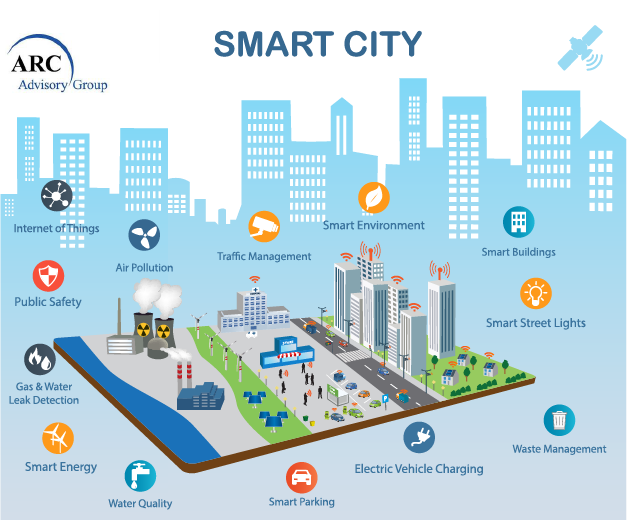
Source : ARC Advisory Group
When will we get there?
5G will rely on super high frequency to keep its promises and therefore it requires infrastructure improvement. In spite of the 77 operators currently trialing 5G technology across 49 countries, the CAPEX-intensive nature of network upgrades means that the next gen of mobile Internet won’t appear overnight, especially in Europe as we lag other regions like the US, Japan and South Korea. That said, Telcos already showed strong commitments to renew their data roaming offers and are largely involved in the spectrum auctions.
The creative destruction
5G will greatly foster the automation of industries, mainly by reducing the cost of big data analysis. As a result, 5G will accelerate cloud business investments. While we are not today at the point where the next gen becomes mainstream, one thing is clear however: companies, operators, and cloud businesses will have to develop and implement a proper 5G strategy. 5G technologies promise to deliver “cluster-innovation”, which is at the center of Schumpeter’s “creative destruction” concept and the true driver of business cycles, according to the Austrian economist. For investors, it means a time of opportunities.
5G and the trade/tech war
Huawei is a flower of the Asian tech landscape, not only because it took the leadership from Apple in the smartphone market, but also because it is a champion in 5G infrastructures. However, Trump decided to blacklist the Chinese company, arguing risk of espionage. Huawei’s CEO profile is in focus: Ren Zhengfei is indeed a former Chinese military engineer and member of the Chinese Communist Party. This move highlights the political stakes around the new 5G technology, which is now at the center of the trade war initiated by the US President.
The above references an opinion and is for information purposes only. It is not intended to be investment advice. Seek a duly licensed professional for investment advice.
MT Finance - Mathias Talmant.


Commentaires