

How is Uncle Sam doing during the pandemic?
- Mathias Talmant

- 13 avr. 2020
- 17 min de lecture
COVID-19 Series

Abstract
The United States had the luxury of advanced notice, but President Trump disregarded the many warnings. New York became the new epicentre of the pandemic and yet the White House is hinting a reopening of the economy in the near future because “we cannot let the cure be worse than the disease”. Two academics at the University of Chicago concluded that the absence of government action would lead to 3m deaths in the US (>22k deaths on13/04/2020). By contrast, a minimal social distancing would cut the death toll down to 1.7m. Age-adjusted estimates of the value of the lives saved make those 1.7m people worth about USD 8tn or 40% of the US GDP.
Whether Mr Trump is ignorant or motivated by his own self-interest, we can all agree that so far, the first economic power has managed this global crisis very poorly. The recipe for this public health fiasco relies on three explosive ingredients: a slow decentralised power, a prohibitive health care system and a defective supply chain weakened by years of trade wars. The $2tn CARES act will put some butter on American’s bread, but it will not head off the unemployment surge, which could surpass the post-GFC level by next month. COVID-19 is a global attack against humanity, then the response should be global as well. It is vital to share best practices, resources and data to restrain the spread of the virus. This should teach nations a good lesson on humility, solidarity and transparency.
Better late than never, but never late is better
“There have been as many plagues as wars in history, yet always plagues and wars take people equally by surprise”, Albert Camus.
That certainly is true for China. Wuhan did not have the luxury of advanced notice and preferred to cloud the issue. However, Europe and the US had several weeks’ notice and they still buried their head in the sand because it was “a Chinese issue”. President Donald Trump promoted denial and minimised the impact of the “Chinese virus” by blaming media for passing on fake news.

The country has some of the world’s best epidemiologists and physicians, but it took weeks before the White House realised COVID-19 was not a benign flu. A few misjudgements later, in early April, the United States is now number 1 on the leader board with close to half a million reported cases and 15,000 reported deaths. On March 28, the President alluded to a state quarantine of New York, the epicentre of the outbreak in the US. A measure which is questionable from a legal perspective, since it is the role of states and local governments to take the lead in preventing the spread of diseases, still has the merit of taking the pandemic seriously.

What doesn’t kill you…
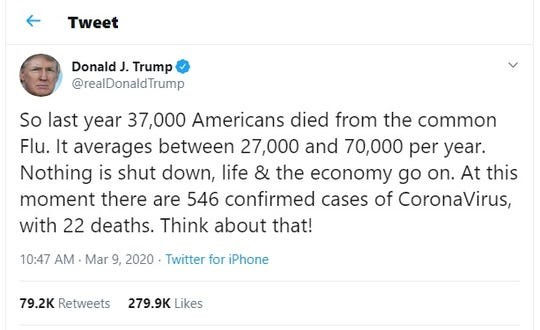
A few days later, the unpredictable Twitter aficionado did an about face and declared that he “would love to have the country opened up and just raring to go by Easter”, ie. on April 12. Mr Trump dismissed his medical team’s warnings and only considered the absolute number of deaths before concluding that COVID-19 was no big deal compared to the seasonal flu. He added that quarantines would be more detrimental to the economy than the virus itself because it would trigger a massive wave of suicides among people forced to stay at home for months. So far, NY suicide helplines have noticed a surge in phone calls from people reporting high level of anxiety - some of which may be caused by the government’s clumsiness. Nevertheless, there is no evidence that suicides will rise dramatically because of social-distancing and record high unemployment. Historically, Dr. Christine Moutier of the American Foundation for Suicide Prevention said that in most instances, during times of national crisis, “suicide rates diminish” as citizens tend to pull together during duress.
It is counterintuitive, but economic evidence indicates that mortality is procyclical: it rises in periods of economic growth and declines during downturns. As pointed out by The Economist, “a study published in 2000 by Christopher Ruhm, found that in America a 1% rise in unemployment was associated with a 1.3% increase in suicides, but a decline in cardiovascular deaths of 0.5%, in road deaths of 3.0%, and in deaths from all causes of 0.5%. In the Great Depression, the biggest downturn in both output and employment America has ever witnessed, overall mortality fell”. Thus, the general belief supported by the President of the US that higher GDP translates into better health and wellbeing and vice versa is not so straightforward. The following figure shows the impact of a three-percentage-point rise in unemployment rate on mortality rates in EU countries.

In the end of the day, a study published by the OECD suggests that the effects of downturns on health seem contingent on policy. Increased spending on programmes that help people get jobs, on the other hand, seems to reduce the effect of unemployment on suicides. It is an ironic situation to notice that some of the detractors of the XXL 2020 rescue package, who are arguing that the action will lead to poorer public health in the future, were supporters of the post-GFC austerity, which led to the same effects.
Because silent spreaders cannot be accounted for, data on infections are unreliable, and thus politicians and rearchers tend to focus on reported deaths. Yet new statistics suggest that current fatality numbers are only the tip of the iceberg. As the economy is shut down and most people are stuck at home, road accidents will certainly decrease while domestic violence may increase. Official death tolls for COVID-19 may exclude people who died before they could be tested. They also ignore people who succumbed at home or to other causes, perhaps because hospitals had no room to treat them. Figures should also be considered wisely as the frailest victims, were already likely to die of other causes. Therefore, it is hard to know the exact death toll of the pandemic and whether the lock down is a net positive or net negative. In several hot spots Spain, Italy and France, authorities have witnessed excess deaths not attributed to COVID-19, which suggest that official figures are largely underestimated.

America First or Business First?

The Easter Bunny would be better off postponing the egg hunt after the infection peak and so would the President be for the lockdown. The President is right on one thing, draconian lockdowns are not the answer to stop the spread of the disease. However, they can contribute to a large extent by reducing the reproduction factor (as detailed in my article on COVID-19 modelling). By saying that “the cure cannot be worse than the problem”, the President prides himself for bringing the wellbeing of his patriots to the fore by calling for a business resumption.
Two academics at the University of Chicago modelled the impact of COVID-19 on the US and concluded that the absence of government action would lead to 3m deaths. By contrast, a minimal social distancing would cut the death toll down to 1.7m. Age-adjusted estimates of the value of the lives saved make those 1.7m people worth about USD 8tn or 40% of the US GDP. In these circumstances, it is hard to believe that the cure will be worse than the problem, but I will let you judge whether this sudden change of opinion on social distancing is a rush of philanthropy or rather a sociopath trait.
To help you make up your mind consider two things. Firstly, Mr Donald Trump passed himself off as the Ugly Duckling stating on Twitter that the lock down was a political manoeuvre orchestrated by “Lame Stream Media” to hamper its re-election hopes. He is so self-centred on his own success that he overlooks the global scale of the crisis and keeps thinking about its election campaign.
Secondly, Mr Trump wears several hats. President of the United States of America is one, multi-billion-dollar businessman is another. It is in his own self-interest to get people “back to work ASAP” and back to put some money up, if possible, in his golf resort, hotels or casinos. As written in The Economist, “a government trying to privilege the health of its economy over the health of its citizenry would in all likelihood end up with neither”. Scott Gottlieb, former commissioner of the FDA, replied to Mr Trump's plans in a wiser tweet.

After Asia and Europe, the US is the new hot spot
Putting an end to the lockdown on Easter Day or anytime soon would be a terrible mistake and the following figure depicts why. The spread of COVID-19 and its death toll are very concerning, especially in the United States. The number of total daily deaths has been multiplied by 100 between March 1 and April 9 and the peak is still ahead of us. The “Wuhan virus” as Trump named it, is now a global virus. After overwhelming Asia and Europe, the new epicentre of the coronavirus took up residence in the land of plenty. Halting social distancing would only fill hospitals and worsen the issue.

America is number one in the leader board for reported cases and deaths (doubled in less than 10 days), and this is only accounting for people who have been tested. Correcting for timing since the average daily deaths passed three, the US curve is steeper than any other country's including Spain, Italy and France. On a smaller scale, New York, New Jersey, Michigan, Louisiana, California and Massachusetts are among the most impacted. The death toll is climbing ever faster in New York while new deaths in Lombardy and Madrid are flattening off (10/04/2020).


We could be tempted to extrapolate that after a month or so, most countries would follow the same trend as China. However, as pointed out by The Economist, erratic infection numbers reveal a puzzling link between COVID-19 cases and political events, so I don’t expect the second derivative to turn negative over the coming month.

Based on a questionnaire sent to a panel of epidemiology experts, whose predictions tend to be more accurate than those of sophisticated mathematical models, the infection peak is most likely to occur in May in the United States. Using the SIR model, my personal estimate of the infection peak date worldwide was July 15, 2020.

Recipe for a public health fiasco
How did the American messianism morphed into the American mess? How can the first economic power be so little prepared to handle a global crisis? For once, President Trump needs to handle a crisis he did not generate himself. Without considering poor leadership, I can see three major reasons explaining the American walloping. Two of them are structural - power decentralisation and prohibitive health care – and one is circumstantial – trade war.
1. Start with a pinch of political disorder
What does “US” stand for? In theory it means “United States”, but it is not so straightforward if we refer to the American legislation. “In the dual-sovereign system of American federalism, states are the plenary sovereigns, each with their own constitution, while the federal sovereign possesses only the limited supreme authority enumerated in the Constitution” (Wikipedia). This means that each state oversees its finances and manages its own public health system and health monitoring in a relatively autonomous way. The first challenge revealed by the COVID-19 crisis is the absence of coordinated response between the 50 states. Governor Cuomo in New York and Governor Newsom in California took drastic measures to promote social distancing, but decentralisation slowed down the flattening of the curve when it was most critical.

Maybe President Donald Trump should take inspiration from Germany, which partially abandoned its "divide and rule" model. In spite of its federal system, Germany proved to be one of the most resilient countries in Europe when dealing with the outbreak. The struggle against infectious diseases is handled by Länder (states of Germany), which means the federal government must come to an agreement with them in order to promulgate containment rules. This decentralised structure jeopardised the safety of the population since it left room for heterogeneity in the country’s COVID-19 response. In this perspective, the Bundestag (Parliament of Germany) passed a law on infections protection, which gave more authority to the Federal Minister of Health in times of epidemic. Federalism as defined in the Constitution is called into question, but is a necessary step to save human lives thanks to a coherent policy on a national scale.
Germany’s resilience is also anchored in its ability to efficiently scale up the number of COVID-19 tests. Early identification of sick people allowed the country to isolate infectious individuals, reduce the reproduction rate (R0) and gave some respite to hospitals while they were enhancing their capacity. This leads us to the next point.
2. Mix it up with a doomed health care system
Maintaining a healthy population requires people not to spread the disease, but also to seek treatment without worrying about crippling debt. Without talking about the student debt bubble, America is one of the few countries in the developed world that does not mandate paid sick leave. A mere 20% of low-paid, service-sector workers can count on it. Those without cannot stay at home, because a retail worker cannot just fire up Zoom as a white-collar office worker might.
The pricey US health care system is also fuelling a vicious circle as uninsured or underinsured US citizens, fearful of surcharges, are reluctant to be tested and thus are more likely to help the epidemy linger on. Democrats secured a commitment from the CDC (Center for Disease Control and Prevention) Chief to cover the cost of a full battery of coronavirus testing (~$1,300). But the issue goes beyond the cost of a simple test. The whole US health care system is defective and the cost of insurance is simply prohibitive.

Every legal citizen of France has the right to use health care and even expensive illnesses are efficiently covered by the law of universal coverage whereas in the United States, 40% of the citizens do not have adequate health insurance. This is because the federal government does not guarantee universal health care. Government-run programs like Medicare (for 65+ or under 65 with disability) and Medicaid (for very low income) exist, but there is no safety net for the middle class. In 2010, Obamacare made health care more affordable for everyone by lowering costs for those who can afford them. Nevertheless, the land of milk and honey conserves the most expensive healthcare system in the world in terms of health expenditures per capita.

The American dream is fading with its citizens’ wealth and wellbeing. In the Time article “COVID-19 Testing Is Supposed to Be Free. Here's Why You Might Still Get Billed”, Jena Starkes, a 45-year-old living with her 81-year-old mother in Brooklyn made frightening comments about the virus: “If I get it and I give it to her, it is unlikely that she would survive. If I get it bad, I would probably just die. What if I had to be ventilated? What if I had to pay $300 for a test? I literally could not.” This is happening in the United States of America. From March 18, a new law mandates that Medicare, Medicaid, other government plans, and most private plans cover COVID-19 testing for free. However, health plans have to cover what it considers to be a “reasonable charge,” the difference with what the provider actually bills is on the taxpayer.
Jena Starkes added : “There’s an awful lot of ex-middle class people like me, who have slipped under the radar, who make way too much money to qualify for government assistance, and yet absolutely cannot pay the ‘affordable’ insurance costs every month.” This curse of the middle class is also a reality in European countries like France. But we should render to Caesar what belongs to Caesar, the new law offers two noticeable solutions for the 27 million American who are uninsured. It gave $1 billion to the National Disaster Medical System and boosted Medicaid inclusion scope.
In the meantime, practitioners steer patients toward hospitals, which are already overstretched because successive budget cuts have slashed the number of hospital beds years after years. The recrudescence of chronic diseases (diabetes, obesity, respiratory issues…) and the large population of are other ingredients for the recipe of a public health fiasco. In 2016, the US had 2.8 beds per 1,000 inhabitants vs 12 for Korea and 8 for Germany. Unsurprisingly, the two latter are amongst the most prepared as they are some of the biggest spenders on public health.

The Economist estimates that up to 20% of US citizens may fall ill with a fatality of 0.5%, leading to ~330,000 deaths, ie. nine time that of a typical flu season. Tight budgeting, bureaucratic blockages, decentralisation of authority and faulty test-kits can be blamed, but I’m not sure whether the US deserves the dunce cap. In my opinion, India, the second most populated country in the world, but also one of the least prepared to handle a pandemic, may well be the next hot spot. It is also one of the countries with the lowest number of tests performed. As shown on the next graph, the United States are well behind South Kora, Italy and Germany.

In order to flatten the exponential curve of infections, it is crucial to increase identification and isolate undocumented infections because it is primarily due to “stealth transmission”, as people with mild or non-existent symptoms continue to move and unknowingly spread the disease. But the truth is the health care system and politicians were all taken off guard and more time is needed to scale up production of test-kits. The White House promised capacity of 1mn tests by March 6th and as of March 11th, only 7,000 had been performed. Many more tests must be performed, but as detailed in my previous article on “All you need to know about the 2019 coronavirus”, a shortage of swabs is congesting the supply chain. This brings us to my last point.
3. Sprinkle generously with aggressive protectionism
In August 2018, Matt Rowan, president of the Health Industry Distributors Association (HIDA), warned against the national security issue resulting from Trump’s tariffs: “The healthcare products on the proposed list are used widely throughout healthcare settings and are a critical component of our nation's response to public health emergencies.” His warnings went unheeded and thus, integrated supply chain vulnerabilities started to backfire. The United States are now experiencing shortages and higher costs of vital equipment at a time of nationwide health crisis.
The two preceding points were not related to Mr Trump’s presidency, but this one surely is. As part of his “America First” policy, he slammed a series of tariffs, especially on China, in order to reduce the United States trade deficit. This started in early 2018 with solar panels and washing machines and then extended to commodities, electronics and medical equipment. Several studies pointed out that Trump's tariffs had adverse outcomes on real income and GDP in the US (Amiti et al., "The Impact of the 2018 Tariffs on Prices and Welfare", Journal of Economic Perspectives, 2019), but this is beyond the scope of this article. One of the many ripple effects of this set of protectionist measures is now threatening to cripple the US fight against the COVID-19 pandemic.
There are three key elements worth highlighting from the next two graphs:
China is the major supplier of Personal Protective Equipment (43% of world imports of face shields, protective garments, mouth-nose-protection equipment, gloves, and goggles in 2018).
China remains a net exporter, but exports have largely decreased since it has also imported a lot for its own population.
China has not been resentful and keeps delivering to the US.
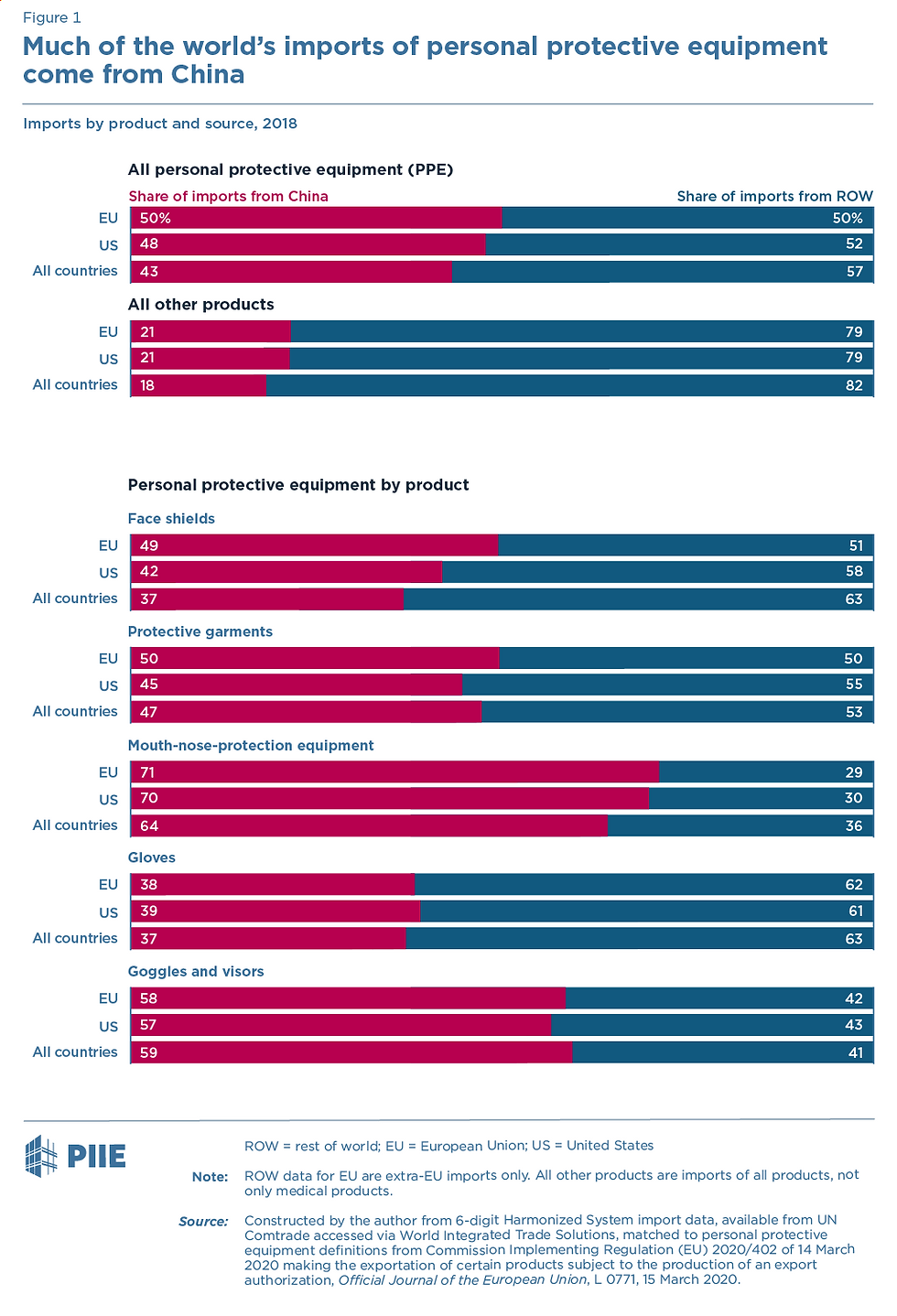

President Trump discretely and temporarily suspended his 7.5% tariffs on some products on 10 and 12 March 2020. This reversal serves as an implicit indictment of his administration’s own policy. In spite of the “phase one” trade agreement that was signed with China on 14 February 2020, additional tariffs persist on $360 billion of imports from China and tensions remain elevated. The Peterson Institute for International Economics showed that the trade war continues to hinder the availability of medical products. Today, $1.1 billion of imports bought to potentially treat COVID-19 remain subject to Mr Trump’s 25% tariffs. His duties on $3.3 billion of imports of other critical health care products were cut to 7.5% from 15%.

“America First” looks good on paper but producing everything at home does not constitute an optimal use of resources. We learn in high school the idea of David Ricardo that an economy should specialise in those activities for which it has a comparative advantage; those where it can produce goods and services at a lower opportunity cost than trade partners'. This is a fundamental principle in the theory of international trade where voluntary trades can be mutually beneficial, and yet countries like the US are promoting protectionism. In my view, the US will be worse off either way because bringing back health care facilities or switching to non-Chinese suppliers will imply additional costs for interoperability testing, procurement and FDA approval. These financial resources instead could have been spent on patient care or cutting costs.
Beside unnecessary costs and bottlenecks, Trump’s continued mistreatment of his trading partners also makes it difficult now to get new sources of supplies. In such times of shortages, perverse incentives could easily encourage Chinese medical suppliers to make American customers their last choice. China does not seem to be to resentful for now, but some European allies are now lashing out and restricting the flow of medical equipment for the US. As of now, exports figures do not seem to confirm such behaviour. However, this should serve as a lesson for future foreign policy because such export restrictions could easily multiply and result in a downward spiral of protectionism. As mentioned by VOXEU, “President Trump should give the American public every chance they need to fight this pandemic by allowing medical professionals and hospitals access to the highest quality, lowest cost, and most accessible supplies, from wherever they can be sourced – including China.”
Unemployment and the response
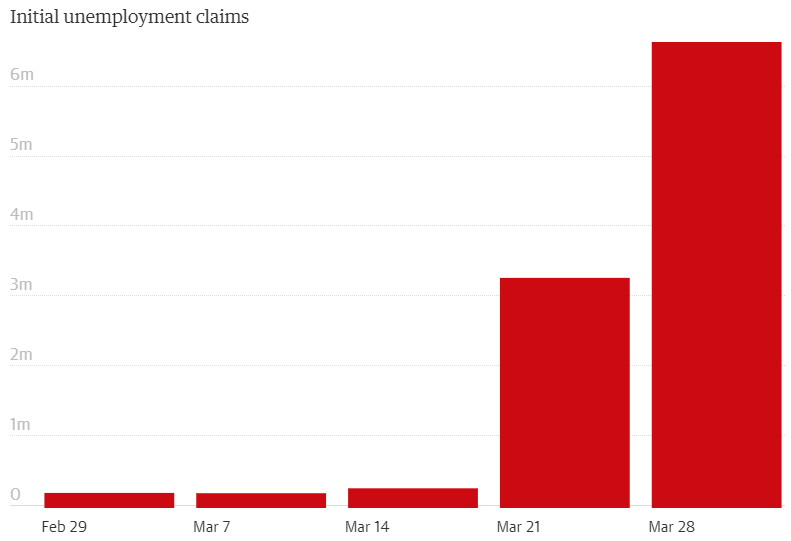
COVID-19 has officially ended the streak of 113 consecutive months of payroll gains. March non-farm payrolls, a key indicator for economic activity, have clearly undershot consensus (-100k) with a reading of -700k and April is likely to be even worse. Government websites collapsed as total claims for unemployment have skyrocketed to close to 10 million in the end of March 2020. In New York City, which now accounts for roughly 6% of global COVID-19 reported deaths, has seen a 1,000% increase in claims. This is the worst data release of the US labour market since March 2009 and it could soar post-WW2 high of 11% according to Nordea. Surprisingly, the S&P500 conserves its positive momentum since March 23.
Sources: The Guardian and US Department of Labour.

Almost all actors of the economy are at least partially impacted by the pandemic, but sectors which are suffering the most are: accommodation, food services, arts, entertainment, transportation and manufacturing industries. US Treasury secretary Mnuchin has predicted unemployment in the US, which was close to record lows before the pandemic, could reach 20%. This pandemic has started the most devastating crisis since the Great Depression, but no worries, helicopter money is coming. The US Congress and the Senate have agreed on a $2 trillion (6% of the US GDP) CARES Act, which stands for Coronavirus Aid, Relief and Economic Security. This package will support consumption via direct payments to taxpayers as well as bailouts for hard-hit industries, but it will not head off the surge in unemployment.

Over the last decades, the United States conserved the leadership for its technological advantage and its ability to deal with global crisis, but COVID-19 has unveiled its Achille’s heel. Washington has managed the crisis very poorly so far, but so as most countries in the world. Does it mean that we will see a Great Power transition in the future? May China outshine the US? Only time can tell, but history can be a guide. After the Subprime, the United States were broken down, but they finally emerged stronger than ever and reaffirmed their status as global leader. The US regained prestige thanks to massive bailouts, Fed interventions and the rise of new technologies.
My personal thoughts
The Subprime crisis taught us systemic risk from a financial perspective, but this crisis is of another nature. Both are inherent to a sudden loss of confidence, but we are now experiencing a health crisis whose scope goes beyond shenanigans and value destruction. Many small businesses will probably go bust, but worse than this will be human losses. The virus makes no distinction between rich or poor, men or women, successful or miserable, young or old, erudite or uneducated and black or white. Even though some stratums are more at risk, Earthlings are equally impacted as one third of the world population is in quarantine. No one will remain unscathed and I can assert with a high degree of confidence that there will be a before and after COVID-19 mentality, as there have been after the GFC.
The seriousness of the outbreak should be emphasized, without for all that giving in to panic. Citizens‘ willingness to abide by restrictions depends both on their sense of self-preservation and on a sense of altruism. As President Trump discredits the virus and his medical team, the perception of the risks the disease poses both to themselves and others begins to fall but ending the quarantine now would be a terrible mistake because it would reignite the reproduction rate. It is not realistic to imagine that confinement will last until we find a vaccine, but governments need an exit strategy. Pressure should be eased progressively and infected individuals should be tracked, even if this means losing some privacy.
It is vital to share best practices, resources and data to restrain the spread of the virus. This should teach nations a good lesson on humility, solidarity and transparency. Unfortunately, in the pursuit of their sovereign functions, some governments adopted a spirit of “après moi, le déluge”. Cooperation is not in the cards when we can read in the news that US bidders have bought up mask shipments right on the tarmac as they were about to set off for France. While honesty and humane decency are the most needed, we are witnessing a global free-for-all where the rules of fair play made way for strongarm tactics. Unscrupulous behaviours have underscored the mounting anxiety over mask shortages and governments themselves have changed their health advice to cover up their shortage.
There were candles in the streets after 9/11 and after Paris attacks because patriotism and collective fervour prevailed over fear. It is okay to walk by on the other side of the road, but don't disconnect from the outside world. There is always something you can do to make the world a better place. I see many people clapping from their balcony at 8 o’clock every day. This is well-intentioned, but it is worth nothing if you do not do your bit to flatten the curve (Five ways you can help during the pandemic).
Stay united, stay home, stay informed, stay sceptical.
The above references an opinion and is for information purposes only. It is not intended to be investment advice. Seek a duly licensed professional for investment advice.
MT Finance - Mathias Talmant.


Commentaires